
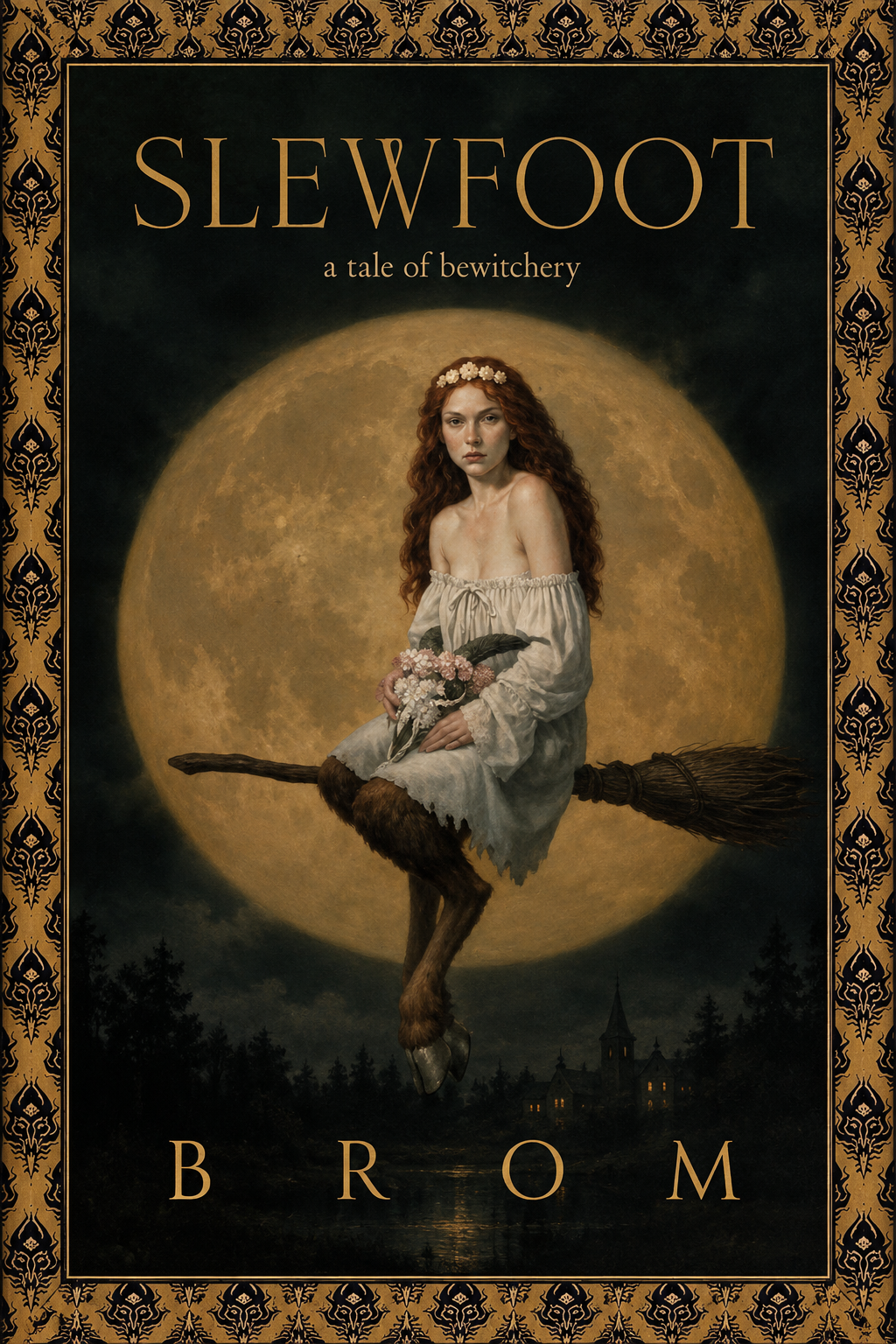
October is the harbinger for the final, most festive months of the year. I wanted to set the tone right with a great, spooky book, and my most anticipated read was Slewfoot: A Tale of Bewitchery, written by Brom. It had caught my attention on a Barnes & Noble bookshelf back in 2021 and had let it collect dust on my TBR for several years. Given the current political climate, my intuition said it was time to crack it open.
Slewfoot is what you get when you marry Arthur Miller’s The Crucible and Guillermo del Toro’s Pan’s Labyrinth— two works of art that transcend time. Brom gives us an exceptional story of feminine rage and survival and an exhilarating critique on patriarchal structures built around fierce magic and grit.
Premise
In the year 1666, Abitha, a young bride, was sold in an arranged marriage to a demure man, Edward Williams. They lived on a humble farmstead on the outskirts of the remote Puritanical town of Sutton, Connecticut.
Edward’s older brother, Wallace, was a fiendish man, but highly protected as one of the founder’s sons and a respected man of the church for his piety.
Many of us know that in this time, women were property; they had no rights, spoke only unless spoken to, and were reprimanded for made-up delinquencies. The church served as the panopticon for the town. Murmurs, gossip, rumors circulated about Abitha being a “cunning” woman and a witch, but was shielded by her husband. To Abitha’s misfortune, she became widowed and received various threats by her brother-in-law to claim her land and subjugate her into servitude.
At an uncanny moment, an ancient forest spirit makes an ominous appearance on the outskirts of town. People believe that the presence of Satan is upon them. The critters of the forest, known as the wildfolk, reverently call him Father. So what is he— a brutal devil or a blessed deity? This read brilliantly takes us through a macabre walk within the gray areas of human morality.
On a Woman’s Freedom
A woman can only take so much pain, humiliation, and abuse before she becomes a threat— a force to be reckoned with. I found Slewfoot to be a cautionary tale for those who push a woman to a point where she says, enough is enough!
Abitha is our anti-hero with an idiosyncratic view of God, making her the town’s pariah. She leans into pagan practices like carrying braided hair for protection and ancestral connection, creating love charms for the townswomen and talismans for keeping evil entities away. These practices rely on her connection to nature, her ancestors and the earth.
Her practices trigger anxieties and fears in the town because she is a woman who is quite sure of herself. The concern lies in what happens when a woman discovers her autonomy, equality, and capacity for leadership: patriarchal structures run the risk of losing their dominion and control over her.
Early in the book, Brom echoes the unsettling plight of women’s history. A life that has been negotiated by the men and the church around them. Already deemed an outsider, her ways were scrutinized and judged with virtually no support from her community. After losing Edward, not one day into widowhood, Abitha is left vulnerable to her vulture of a brother-in-law and the whole town gawking to witness her impending failure. Thus began her fight for her survival.
believing one is superior is at the heart of all abuse.
Kimberly Key Ph.D | Psychology today
The constant surveillance, the brutality of men, policing social structures and betrayal from the very community you live in can make many marginalized individuals feel alone and vulnerable. These institutions are upheld by the marriage between church and state where governing bodies define what constitutes good and evil, resulting in baseless murders and femicide.
Abitha, innocent of any crimes and a victim of a literal witch hunt, faces accusations from Wallace, the magistrate and clergymen. The treacherous charades and the lies from the very same young women she had helped, reflected the heartbreaking scene from the witch trials in the Crucible. All were ready to sacrifice her and see her neck broken by the gallows in the name of God.
Before Abitha is sent into a vengeful killing spree, the beast that puts her in harm’s way is Ansel Fitch, the self-appointed witch hunter who spies on Abitha, to find evidence of “deviltry”. His surveillance mixed with oppressive ideologies parrots the recent addition of cameras surveilling women seeking reproductive healthcare across state lines. Although Abitha was not seeking reproductive healthcare, she was building a foundation for an independent life as a widow (a very uncommon thing for a woman in those times). This is a disturbingly persistent method of patriarchal control. If women are watched closely enough, their private choices and livelihoods become opportunities for male-centric systems to police women.
While speaking to Samson, Abitha Williams shares a yearning for nature and a desire for freedom, which resonates with many women who have experienced oppression.
You will think me foolish. But I wanted to be a fairy queen, to run barefoot through the woods, to sing like a bird and fly through the trees… To be able to talk to the animals.
Abitha williams
She has had to suppress this dream for many years. To be free! Androcentric societies have often tried to sever a woman’s tie to mother nature and men knowingly or perhaps, unknowingly, harm women by obstructing their cultural, historical and philosophical ties to the earth. This, I felt, was the core theme of the book. A reclamation of the bridge between women and nature. Abitha’s transformation was an illustration of a dark apotheosis, living wild and free within the forest that gives her energy and life.
We see this parallel in Samson in goat form. He goes into Mamunaphet’s cave, the shaman’s museum of lost souls, and has an awakening, experiencing his own apotheosis. He was bestowed with a false narrative that being a dark slayer was the epitome of his life. But he strips his oppressor of power and reclaims his fractured identity. Samson walks away, transformed as a Golden Stag, unbound, and knowing exactly who he is— the protector of the forest.

Slewfoot challenges the morality imposed by Abrahamic religion by reconsidering who and what is denoted as evil. I found that Samson’s morally ambiguous nature parallels the Faun from Pan’s Labyrinth. Neither creature comfortably fits our expectations of the dichotomy of good and evil. They are ancient, unsettling, powerful, and difficult to trust.
However, Brom cleverly turns the Puritan fear of paganism against itself: while the community searches the forest for the Devil, we consider whether greater evil resides in the systems built to police one another in God’s name. The townspeople see Samson’s antlers and monstrous form and believe they know exactly what he is, Satan. This reversal is what makes the novel so delicious. The monster looks like a monster, while church cruelty disguises itself in piety and behaves worse than any monster we can conjure up.
After the cathartic slaughter of Sutton, Abitha lives the life she always wanted. The life the readers wanted for her. To live unbothered and reconnected to nature apart from destruction and misogyny. Then we ask again: does it even matter if Samson is a deity or a slayer? Abitha stops trying to appease the patriarchal hypocrisy governing her life. She triumphs in an iconic realization: she is that pagan witch!
Affiliate Disclosure: Hey reader! Some of the links below are affiliate links. This means if you choose to make a purchase, I’ll earn a commission. This commission comes at no additional cost to you, and it helps keep this site running!
References
Slewfoot: A Tale of Bewitchery– Brom
The Feear Behind Women in Power https://www.psychologytoday.com/us/blog/counseling-keys/201608/the-fear-behind-women-in-power
Leave a Reply