
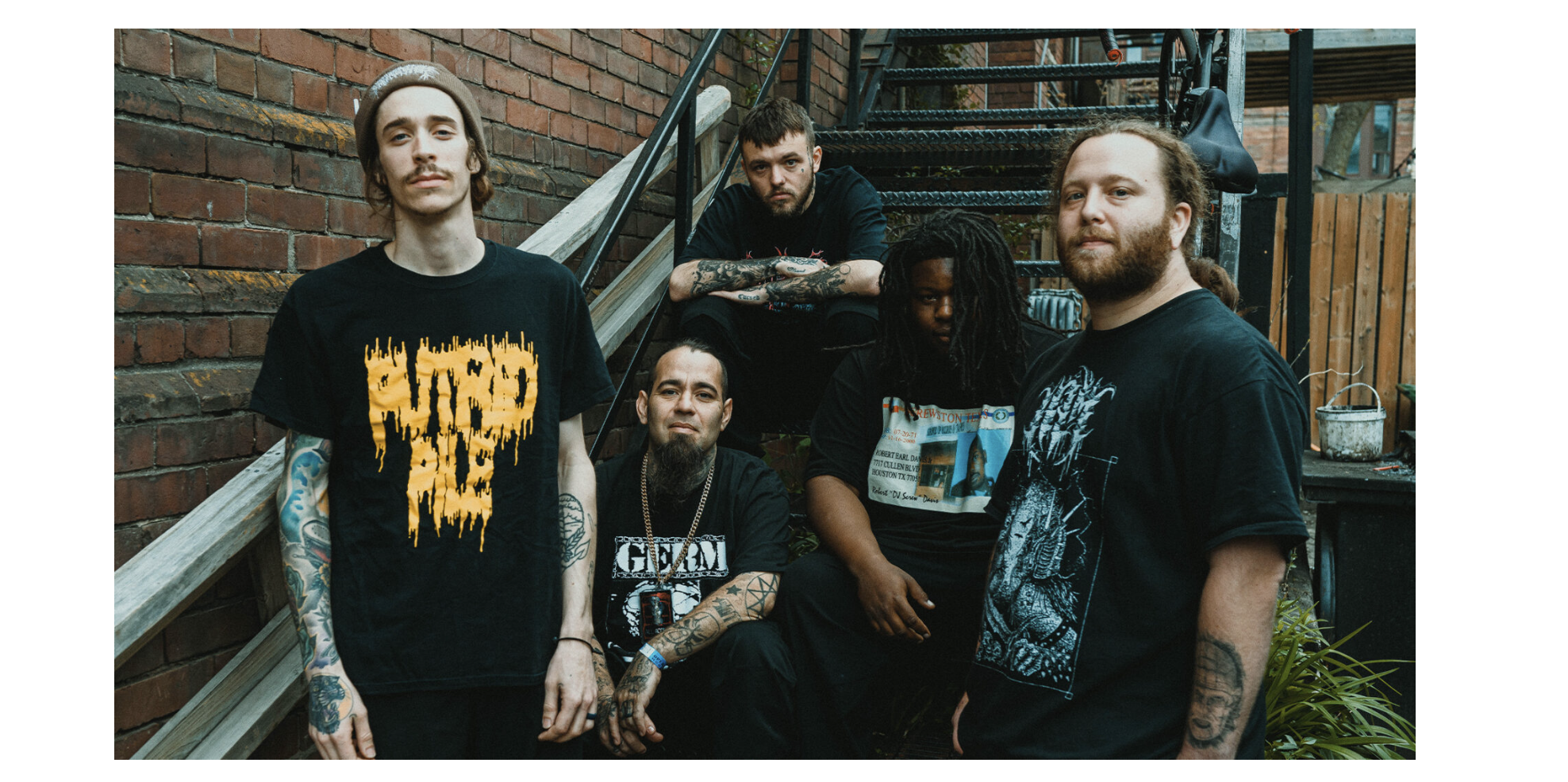
And welcome to the stage—
PeelingFlesh, from Oklahoma.
Damonteal Harris, one of the roughest, toughest vocalists in slam death metal.
Jason Parrish, heavy on the guitars.
Energy on full, guitarist, Mychal Soto.
At the core, bassist, Austin Hirom.
And behind the kit, aura-farming drummer, Joe Pelletier.
By colliding slam death metal with hip-hop, the rising Oklahoma band is helping heavy music evolve while reminding listeners that Black culture has never existed outside metal’s gates.

What sets them apart ?
Formed in 2021 and fronted by vocalist Damonteal Harris, PeelingFlesh has quickly become one of the most recognizable names emerging from the underground slam scene. Its 2024 debut album, The G Code, introduced a wider audience to the band’s distinct fusion. The follow-up EP, PF Radio 2, arrived in 2025, pushing its riffs, drums, vocals, and samples even further.
Beneath the brutality is music driven by rhythm. Songs such as “Perc 3000,” featuring DJ MRD, use DJ scratching to accentuate the guitar riffs, while the instrumental “Skin Blunt” moves between rap beats, samples, and death-metal instrumentation. Their releases can feel like underground radio broadcasts or old-school mixtapes, complete with introductions, interludes, samples, and abrupt transmissions.
Who Decides What Metal Sounds Like?
Metal has always had listeners who protect its boundaries and others who enjoy watching those boundaries collapse.
Sleep Token encountered a version of this conflict when the British band began combining metal with R&B, trap, pop, and hip-hop. Its growing popularity was accompanied by arguments over whether it was “metal enough.” The controversy revealed an old anxiety within heavy music: what happens when metal no longer follows a recognizable formula?
Gatekeeping extends beyond sound, too. Women have long encountered demands to prove their knowledge before being accepted as “real” metal fans. Genres are subjected to similar litmus tests, with invisible boundaries determining what supposedly counts as authentic metal music.
All members from PeelingFlesh enters that conversation from a far more brutal and epic direction.
Hiram, Soto, Pelletier, Parrish and Harris are not softening metal or making it more commercially palatable. It uses hip-hop to make slam stranger, more rhythmic, and in some moments, even more punishing.
That matters because metal is alternative, it is rebellious. Therefore, it has never survived through purity and strict moral code.
It survives through reinvention.
Jimi Hendrix helped redefine what an electric guitar could do, pushing blues and psychedelic rock toward heavier, distorted territory that would influence generations of rock musicians. Black Sabbath took blues-rooted rock somewhere darker still, while Led Zeppelin pushed blues, psychedelia, and hard rock toward new extremes. Thrash later collided heavy metal with punk. Industrial metal absorbed electronic music. Nu metal brought rap vocals, turntables, funk, sampling, grunge, and hip-hop rhythms into the mainstream. Metalcore fused metal instrumentation with hardcore breakdowns.
Every generation changes the genre.
Someone without fail accuses that generation of ruining it.
What purists call a contamination, I call a cross-pollination.
Black Culture Was Never Outside Metal
The presence of a Black frontman also carries significance within a scene still frequently imagined as overwhelmingly white.
But Damonteal Harris should not be treated as a curiosity, or as proof that Black musicians can participate in metal.
Black musicians do not need permission to enter heavy-music spaces.
Their influence already exists within the foundations from which heavy music developed.
Rock and roll emerged substantially from Black gospel, blues, and rhythm and blues traditions. Sister Rosetta Tharpe, was experimenting with an aggressive electric-guitar sound before rock and roll had fully crystallized as a genre. Black musicians later became important figures within punk and hardcore through bands including Pure Hell, and Bad Brains. Contemporary acts such as Soul Glo and Zulu continue bringing rap, sampling, and distinctly Black cultural references into heavy music.
PeelingFlesh continues that lineage in its own gorgeously grotesque way.
I also need to emphasize something, hip-hop samples do not introduce Black culture into some completely separate white musical tradition. Instead, I encourage you to recognize a relationship that has always existed the further back we look.
For Black alternative listeners, Harris’s visibility can matter for precisely that reason. He isn’t standing at the edge of the scene as a guest.
He’s at the center of the fucking stage.

Where to Begin
PeelingFlesh will not be for everyone, but unfamiliarity is not the same thing as bad music.
Start with “Perc 3000” for one of the best examples of turntablism meeting slam. Try my bestie’s favorite, “Make A Move,” if you want to hear the band’s rap influence paired with the sickest groove. Then listen to my favorite, “Intrusive Thots,” from Slamaholics, Vol. 2 to hear how the sound continues to evolve.
If something clicks, play The G Code from beginning to end. It’s short, chaotic, and built to feel like a complete transmission.
PeelingFlesh fuses rap and hip-hop in metal.
And for the metal enthusiast worried that evolution threatens the genre, remember:
When the snake emerges from its peelingflesh, during ecdysis, it’s because it has outgrown it.
Leave a Reply